The best levada walks in Madeira are not ranked sensibly by waterfall size or social-media fame. The useful choice depends on tolerance for narrow edges, dark tunnels, repeated steps, crowds and awkward transport. A nearly level water channel can still demand several hours on wet stone, while a short forest route may feel easier than its statistics suggest. Choose by the part most likely to spoil the day, then check whether the trail is actually open before setting out.
How levada walks differ once the numbers look similar
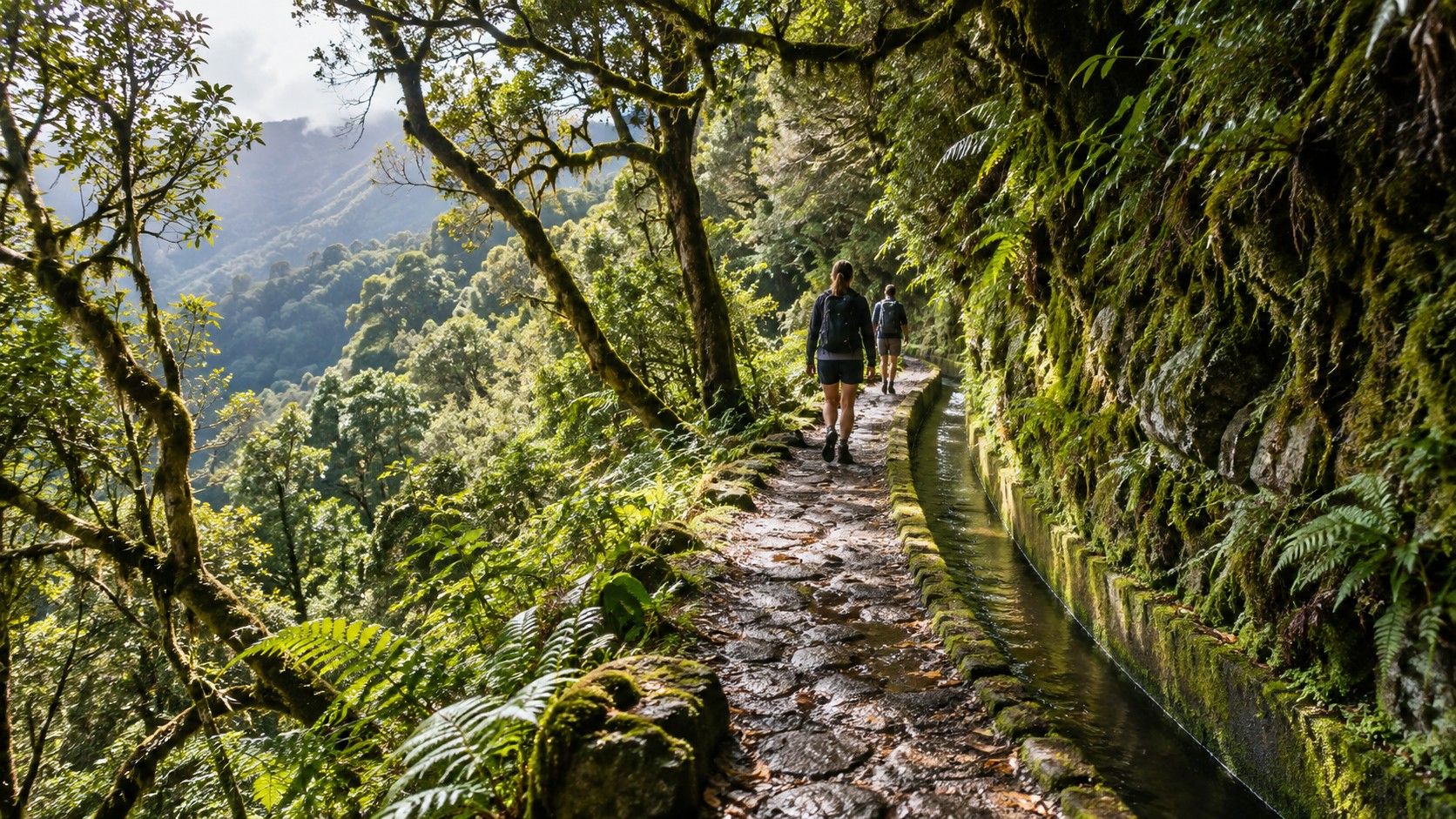
Levadas were built to move water across steep terrain, not to create uniformly gentle footpaths. Many follow a modest gradient, but access paths may descend sharply, climb back to parking or squeeze between the channel and a drop. Distance alone hides this. So does the label “easy,” which can mean little ascent while ignoring exposure or slippery surfaces.
The Laurisilva forest changes the experience again. Shade keeps paths cool and damp, roots cross the surface, and mist can arrive while the south coast remains bright. Waterfalls may be stronger after rain, but so are runoff and rockfall risk. Good footwear matters even on a technically simple route; smooth trainers that work on Funchal pavement are poor companions on wet stone.
Official PR trails are waymarked routes, yet status can change because of maintenance, storm damage or landslides. A familiar name does not guarantee full access. Some routes reopen only in part or with diversions. Check the current official notice for the exact route number on the day, read signs at the entrance and turn back at a closure.
| Route character | Good choice for | Watch for |
|---|---|---|
| Short, broad levada section | First-time walkers and relaxed mornings | Access-road traffic and limited parking |
| Laurisilva forest route | Shade, greenery and atmosphere | Wet roots, mud and mist |
| Waterfall route | Dramatic destination | Crowds, spray and narrow passing points |
| Tunnel route | Adventure and engineering interest | Headlamp, low ceilings and standing water |
| Exposed levada | Experienced walkers comfortable with heights | Narrow edges, wind and vertigo |
Low-commitment walks for a first levada day
For a first attempt, choose a route with straightforward access, modest duration and an easy turning point. The Balcões walk from Ribeiro Frio is not a long levada expedition, but it introduces damp forest paths and rewards a clear day with a mountain viewpoint. It becomes busy, so an early start helps. Cloud can erase the view without making the forest itself unpleasant.
Sections near the Vale Paraíso or Camacha area can offer gentler levada walking close to Funchal, though junctions and road crossings require attention. These routes work well when the group includes mixed abilities because returning early does not sacrifice an entire day. They also reveal whether anyone dislikes walking beside an open channel before committing to a remote route.
The phrase easy levada walks Madeira should never be treated as a promise of dry, barrier-protected pavement. Ask how long the walk is, whether it is linear or out-and-back, how the trail is reached and whether there are unguarded edges. A person comfortable with six flat kilometres may still dislike a narrow two-kilometre ledge.
Start with enough daylight to avoid rushing. Forest shade arrives earlier than sunset, and a minor wrong turn is harder to untangle in dim light. Carry water and a small snack even for a short route; cafés shown near trailheads may be closed or farther away than expected.
Forest and waterfall routes worth the extra effort
Levada do Rei is a strong forest choice when open. It enters lush north-side vegetation and feels more intimate than a broad viewpoint trail. Damp sections and overhanging plants are part of the route, so a waterproof layer protects against both rain and dripping leaves. The return follows familiar ground, which simplifies navigation but can make the total distance feel longer than the outward walk suggested.
Caldeirão Verde is known for deep Laurisilva scenery, tunnels and a waterfall destination. The appeal is obvious; the practical details matter more. A proper headlamp leaves both hands free, while a phone torch is awkward around puddles and other walkers. Taller people need to watch the low tunnel roof. The path has narrow sections where overtaking is foolish, and crowd pressure can slow progress substantially.
Rabaçal's 25 Fontes area offers several linked walking possibilities and a famous waterfall basin. It also attracts heavy demand. Parking, the descent from the plateau and any shuttle arrangements must be included in the day's effort. The waterfall viewpoint can feel compressed at peak time, so starting early or choosing a quieter associated route often improves the experience more than racing for the central spot.
These Madeira levada hikes are attractive after rain, but that is not an argument for ignoring warnings. Strong water, falling debris and flooded sections are different from a photogenic cascade. If official access is closed, use a lower, open alternative rather than searching for an unofficial entrance.
Tunnels, exposure and vertigo are separate decisions
A tunnel route needs one reliable headlamp per person, not one light for the group. Spare power is sensible. Expect wet floors, low sections and water dripping from the roof. Remove sunglasses before entering and give eyes a moment to adjust. Passing inside a narrow tunnel is uncomfortable; wait at a wider section when possible.
Exposure is more personal. Railings may be present in places and absent in others, while vegetation can conceal the size of a drop until a bend opens. Wind intensifies the sensation. Anyone with vertigo should choose a broad forest route rather than assuming fear will disappear after the first kilometre. Turning around is a valid decision, but on a busy narrow path it also requires care.
Levada do Caldeirão Verde, routes around Rabacal and other well-known walks each combine these features differently. Old articles and videos may not reflect repairs, diversions or current restrictions. Compare a recent official route description with the group's limits; do not choose solely from an image of the endpoint.
Children require the same honest assessment. Age is less informative than steadiness, listening and comfort near water and edges. A carrier changes an adult's balance on narrow ground. Dogs may be restricted or impractical around tunnels, livestock and passing points. Check applicable rules before arrival.
Closures, weather and transport decide whether the walk works
Check trail closures twice: during planning and again on the morning of the walk. Weather can force rapid changes. The relevant forecast is for the route's elevation and side of the island, not the hotel. Wind, hourly rain and visibility are more useful than one daily symbol. After severe weather, allow for delayed inspections even when the sky has cleared.
Transport deserves equal weight. Some walks are out-and-back and return to the car; others are linear or end near a different road. Parking at famous starts fills early and informal roadside spaces may obstruct traffic. Trail transfers are often the cleanest solution for a linear route, but pickup times impose a firm walking pace. Confirm the exact meeting point offline.
Public buses serve some villages, not every upland trailhead, and Sunday frequency may be thin. A taxi can solve one direction if arranged in advance. Agree on the named pickup location rather than relying on a forest map pin, and keep a fallback number. Mobile coverage is helpful but not a transport plan by itself.
Match the trail to the weakest point in the group
For greenery without a highly technical day, begin with a shorter Ribeiro Frio-area walk or an accessible levada section near populated areas. For immersive forest, consider Levada do Rei when conditions and status allow. For tunnels and a dramatic destination, Caldeirão Verde is the stronger fit for walkers equipped and comfortable with narrow passages. For the famous waterfall experience, 25 Fontes works best with an early start and acceptance of company.
Pack a headlamp whenever tunnels are possible, a light waterproof, water, food and a small first-aid kit. Wear shoes with dependable grip. Save the route and emergency details offline, tell someone the plan and leave enough daylight for a slower return. Do not enter water channels, climb barriers or stand beneath unstable rock for a photograph.
The best levada walks Madeira offers are those that match the day rather than dominate it. A modest open forest route in good weather is better than a famous closed path approached in rain. Select for exposure, tunnel comfort, transport and current status first; scenery is abundant enough that the safer alternative rarely feels like a consolation.